The Superficial Loss Rule in Canada: How the 30-Day Rule Works
Selling a losing investment to claim the capital loss, then buying it back a few days later, is one of the oldest ideas in tax planning. Canada shut it down decades ago with the superficial loss rule. If you repurchase within 30 days, the Canada Revenue Agency denies the loss — and in one very common case, the loss is not just delayed, it is destroyed permanently.
A superficial loss happens when you sell a capital property at a loss and you (or someone affiliated with you) buy the same or identical property within a window running from 30 days before the sale to 30 days after it, and still hold it at the end of that window. The loss is denied for the year. Normally it is not lost forever — it gets added to the cost base of the repurchased property, so you claim it later. The exception: if the repurchase happens inside your TFSA or RRSP, the loss is gone for good.
What counts as a superficial loss
The CRA sets out two conditions, and both must be met for a loss to be superficial:
- You, or a person affiliated with you, buys — or has a right to buy — the same or identical property (the CRA calls this the substituted property) during the period starting 30 calendar days before the sale and ending 30 calendar days after the sale.
- You, or a person affiliated with you, still owns or has a right to buy that substituted property 30 calendar days after the sale.
The first safe day to buy back is day 31 after the sale.
Two things surprise people here. First, the window looks backwards as well as forwards — buying more of a stock and then selling your older shares at a loss three weeks later can trigger the rule, even though you never “bought it back.” Second, the test is calendar days, not business days, and it is measured from the settlement of the disposition — so a late-December sale needs care.
“Affiliated with you” is broader than you think
You cannot dodge the rule by having someone close to you do the buying. The CRA’s own examples of affiliated persons include:
- You and your spouse or common-law partner. Your spouse repurchasing the same stock in their account triggers the rule.
- You and a corporation controlled by you or by your spouse or common-law partner.
- A partnership and a majority-interest partner of that partnership.
- A trust and its majority-interest beneficiary, or someone affiliated with that beneficiary.
- Your own registered accounts. Your RRSP and TFSA are treated as affiliated with you — which is where the rule does its worst damage. See below.
Notably absent from that list: adult children, parents, and siblings are generally not affiliated persons for this purpose. But do not treat that as a loophole to engineer — transfers to family members bring their own attribution and fair-market-value problems.
The denied loss usually is not lost — it moves
Here is the part most panic-searchers miss. A superficial loss is generally deferred, not destroyed. In the CRA’s words: if you have a superficial loss you cannot deduct it in the year, but if you are the person who acquired the substituted property, you can usually add the amount of the superficial loss to the adjusted cost base of the substituted property. That higher cost base decreases your capital gain (or increases your capital loss) when you eventually sell.
So in a normal taxable account, tripping the rule costs you timing, not money — you claim the same loss later, when you finally sell for real. If cost-base tracking is new to you, our guide on how to calculate capital gains tax walks through the adjusted cost base mechanics.
The TFSA and RRSP trap
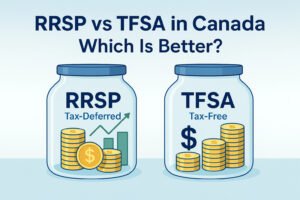
Sell a stock at a loss in your taxable account and buy it back inside your TFSA or RRSP within the window, and the loss is permanently denied. The usual relief does not save you: adding the loss to the cost base of the substituted property is meaningless when the property sits in a registered account, where cost base has no tax effect. The deduction simply evaporates.
This is the harshest corner of the rule and the one people fall into most often, precisely because it feels like good housekeeping — “I was moving it into my TFSA anyway.” Two versions to watch:
- Sell in taxable, repurchase in the TFSA or RRSP within the 61-day window. Your registered account is an affiliated person; the loss is denied with no cost-base relief.
- Transfer shares “in kind” at a loss directly into your TFSA or RRSP. The loss on that deemed disposition is denied outright. The old advice holds: never contribute a losing position in kind — sell it in the taxable account, wait, and contribute the cash instead.
The asymmetry is worth remembering: contributing a winning position in kind triggers a taxable gain, and contributing a losing one destroys the loss. Registered accounts are wonderful; the doorway into them is not. Our guide to TFSA or RRSP covers the wider choice between the two.
What the Income Tax Act actually says
If you want the statute rather than the summary, the superficial loss rule lives in two places in the Income Tax Act:
- Section 54 contains the definition of “superficial loss” — the 30-days-before-and-after window, the substituted property, the affiliated person, and the still-owns test at the end of the period.
- Subparagraph 40(2)(g)(i) does the damage: where a loss is a superficial loss, the taxpayer’s loss is deemed to be nil.
That “deemed to be nil” wording is why the loss cannot simply be claimed later as itself — it never legally existed as a loss. The relief you get in a taxable account comes separately, through the cost-base addition, which is why it fails in a registered account: there is no cost base doing any work there. You can read the definition in section 54 of the Income Tax Act and the CRA’s plain-language version in Guide T4037, Capital Gains.
American readers will recognise the shape of this: it is Canada’s equivalent of the wash sale rule. The mechanics differ — the US window is 30 days either side of the sale as well, but the two systems treat the denied loss and the affiliated parties differently — so do not import US advice wholesale.
When a loss is NOT superficial
The CRA lists specific situations where the rule does not apply even though the timing looks bad. The more common ones:
- You are considered to have sold the property because you became or ceased to be a resident of Canada.
- You are considered to have sold it because you changed its use.
- You disposed of the property and within 30 days you became or ceased to be exempt from income tax.
- The property is considered to have been sold because the owner died — the deemed disposition on death is not caught by this rule. (We cover that separately in our guide to capital gains tax on inherited property.)
- The disposition results from the expiry of an option.
- The property is appropriated by a shareholder on the winding-up of a corporation.
How to harvest losses without tripping the rule
Tax-loss selling is perfectly legal — the rule only stops you from having the deduction and the position at the same time. Three clean approaches:
| What you do | Result |
|---|---|
| Wait 31 days before buying back | Loss allowed. Cost: you are out of the market for a month. |
| Buy a similar but not identical fund (e.g. a different provider’s index ETF tracking a different index) | Loss allowed, exposure maintained — the property must not be identical. |
| Sell and stay in cash until January | Loss allowed, and the gain-offset lands in the right tax year. |
| Sell in taxable, rebuy in your TFSA/RRSP within 30 days | Loss permanently denied. Worst outcome available. |
| Your spouse buys it in their account within 30 days | Loss denied (they are affiliated); relief goes to their cost base, not yours. |
The “similar but not identical” route deserves a caution: two ETFs tracking the same index are, in the CRA’s view, arguably identical property. Switching from one S&P 500 fund to another S&P 500 fund is a gamble; switching from a US large-cap index to a total-US-market index is a much safer distinction. Get advice if the amount is large.
Know what the loss is worth first
Work out the gain you are offsetting before you plan the sale.
Timing matters as much as the rule: a loss is only worth harvesting if you have gains to offset (or expect them within the carry-forward rules). You can size the offset with our capital gains tax calculator or plan the wider picture with our free financial calculators.
Frequently asked questions
It denies your capital loss if you, or a person affiliated with you, buy the same or identical property within the period starting 30 calendar days before the sale and ending 30 calendar days after it, and still hold it at the end of that period. The loss is generally added to the cost base of the repurchased property instead.
The window runs 30 calendar days before and 30 calendar days after the sale, so the first safe day to repurchase is day 31 after the sale. Note the rule looks backwards too: buying shares in the 30 days before you sell at a loss can also trigger it.
Yes, and it is the worst case. Your TFSA (and RRSP) counts as affiliated with you, so selling at a loss in a taxable account and repurchasing inside the TFSA within the window denies the loss. Unlike a normal superficial loss, it is not deferred to a cost base — inside a registered account there is no cost base to carry it, so the deduction is permanently lost. Transferring a losing position in kind into a TFSA has the same effect.
Section 54 of the Income Tax Act defines a superficial loss, and subparagraph 40(2)(g)(i) deems that loss to be nil. The CRA’s plain-language explanation is in Guide T4037, Capital Gains.
No. Your spouse or common-law partner is an affiliated person, so their purchase within the window triggers the rule. The denied loss is added to their cost base rather than yours, which usually is not what you wanted.
It is Canada’s equivalent, and the timing window is similar, but the details differ — including who counts as an affiliated person and what happens to the denied loss. Do not apply US wash-sale guidance to a Canadian account.
Last updated: July 2026 · Definition and exceptions verified against CRA Guide T4037 and the Income Tax Act.
This article is general information, not tax advice. The superficial loss rules are technical and fact-specific — whether two securities are “identical property,” who is an affiliated person in your circumstances, and how the denied loss is treated all depend on details this guide only summarizes. The registered-account points above reflect established professional interpretation rather than a single CRA statement. Confirm current rules with the Canada Revenue Agency and consult a qualified tax professional before acting on a loss-selling plan.