

TFSA or RRSP: How Canadians Can Maximize Savings in 2026
The TFSA or RRSP question has one honest answer: it depends on your tax rate today versus your tax rate in retirement. This guide gives you the 2026 limits, a worked example, and one simple rule to decide where your next dollar goes.
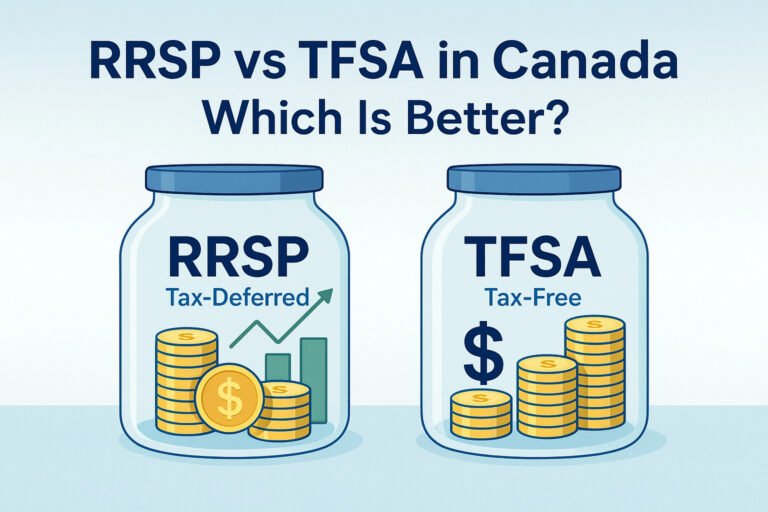
When it comes to personal finance in Canada, the two workhorse accounts are the Registered Retirement Savings Plan (RRSP) and the Tax-Free Savings Account (TFSA). Both shelter your investments from tax, but they do it at opposite ends: the RRSP gives you the tax break now and taxes you later, while the TFSA gives you no break now and never taxes you again. If you are weighing TFSA or RRSP for your 2026 contributions, the right choice comes down to a comparison most people never actually make — and we will make it below.
What Is an RRSP in Canada?
An RRSP (Registered Retirement Savings Plan) is designed primarily for retirement savings.
- Tax deduction: Contributions are tax-deductible. If you earn $70,000 and contribute $10,000, you are taxed as if you earned $60,000 — the refund lands at your marginal tax rate, not your average rate.
- Tax-deferred growth: Investments inside the RRSP grow untaxed until withdrawal.
- Withdrawals are taxed as income: Usually in retirement, when most people sit in a lower bracket. Your institution also holds back tax at source when you withdraw — see the current RRSP withholding tax rates.
- 2026 contribution limit: 18% of your previous year’s earned income, capped at $33,810 for 2026 (up from $32,490 in 2025). Unused room carries forward indefinitely.
What Is a TFSA in Canada?
A TFSA (Tax-Free Savings Account) is the flexible one — useful for retirement, a home, or any goal at all.
- No tax deduction: You contribute with after-tax dollars.
- Tax-free growth: Interest, dividends, and capital gains are never taxed — not while they grow, and not when you withdraw.
- Withdraw anytime: No tax, no penalty. The amount you withdraw is added back to your contribution room on January 1 of the following year (not immediately — see the mistakes section below).
- 2026 contribution limit: $7,000 for 2026, unchanged from 2025. If you have been eligible since 2009 and never contributed, your cumulative room in 2026 is $109,000.
RRSP vs TFSA: Key Differences in 2026
| Feature | RRSP | TFSA |
|---|---|---|
| Main purpose | Retirement savings | Flexible savings & investing |
| Tax advantage | Contributions are tax-deductible | Withdrawals are 100% tax-free |
| Growth | Tax-deferred | Tax-free |
| Withdrawals | Taxed as income + withholding at source | No tax, anytime |
| 2026 limit | 18% of income, max $33,810 | $7,000 ($109,000 cumulative since 2009) |
| Room after withdrawal | Lost permanently | Restored next January 1 |
| Best for | Higher earners deferring tax | Lower earners & flexible goals |
All limits are set by the Canada Revenue Agency — you can verify them on the CRA’s official limits table, and your personal room appears in your CRA My Account.
The One Rule That Decides It
Strip away the noise and the TFSA or RRSP decision is a single comparison:
If your tax rate today is higher than it will be in retirement → RRSP wins.
If your tax rate today is lower than it will be in retirement → TFSA wins.
If they are the same → the two accounts are mathematically identical. Pick the TFSA for flexibility.
Why this works: the RRSP refunds tax at your rate now and charges tax at your rate later. The gap between those two rates is the entire benefit (or cost). The TFSA has no gap to exploit — it simply removes tax from the equation. That is why the RRSP shines for a $110,000 earner (contributing at a ~40% marginal rate, likely withdrawing at ~25%) and quietly backfires for a $35,000 earner, who gets a small refund now and may face clawbacks of income-tested benefits like the Guaranteed Income Supplement later.
Example: A Canadian Earning $70,000
Say you earn $70,000 and have $10,000 to save, at a combined marginal rate of about 30%:
- RRSP: The $10,000 contribution triggers roughly a $3,000 refund. Your full $10,000 compounds tax-deferred. If you later withdraw in retirement at a 20% rate, you keep the 10-point spread — that is real money the TFSA cannot match.
- TFSA: No refund, but if your $10,000 grows to $25,000 over the years, the entire $25,000 is yours — no tax on the $15,000 of growth, ever, and withdrawing it does not push you into a higher bracket or claw back benefits.
Over long horizons the growth itself does most of the work in either account. To see what $10,000 plus regular contributions becomes over 10, 20, or 30 years, run it through our compound interest calculator.
Common Mistakes to Avoid
- Re-contributing to a TFSA in the same year you withdrew. Withdrawn room comes back the following January 1. Put the money back too early without spare room and the CRA charges 1% per month on the excess.
- Forgetting RRSP room is gone forever. Withdraw $20,000 from an RRSP outside the Home Buyers’ Plan and that $20,000 of room never comes back. TFSA room does.
- Using an RRSP at a low income. A refund at a 20% rate that becomes taxable income (plus possible GIS clawback) at 30-50% effective rates in retirement is a losing trade. Low earners should usually fill the TFSA first.
- Ignoring the FHSA if you are a first-time buyer. Since 2023 the First Home Savings Account combines an RRSP-style deduction with a TFSA-style tax-free withdrawal for a first home — for eligible buyers it beats both accounts for that goal.
- Holding US dividend stocks in the wrong account. US dividends inside a TFSA lose a 15% withholding tax that an RRSP avoids — see our guide to US withholding tax in a TFSA vs RRSP.
Deadlines and Age Rules Worth Knowing
The two accounts also run on different clocks, and the differences matter more as you get older:
- RRSP deadline: contributions made in the first 60 days of a year (through about March 1) can still be deducted on the previous year’s tax return. The TFSA has no deadline at all — room simply accumulates every January 1.
- The RRSP has an expiry date: by the end of the year you turn 71, an RRSP must be converted to a RRIF (or an annuity), and minimum taxable withdrawals begin the following year whether you need the money or not.
- The TFSA never expires: there is no age limit, no forced withdrawal, and you keep earning new room for life. That makes it the natural place for retirees to park money they are forced to pull out of a RRIF but do not plan to spend.
- Spousal note: a TFSA is always individual, but on death both accounts can pass to a spouse without immediate tax — the TFSA via a successor-holder designation, the RRSP via a tax-deferred rollover.
Final Thoughts: TFSA or RRSP in 2026?
- Prioritize the TFSA if your income is modest, your goals are flexible, or you may need the money before retirement.
- Prioritize the RRSP if you are in a higher bracket now and genuinely saving for retirement — and invest the refund rather than spending it.
- Use both once income allows: TFSA for flexibility, RRSP for the bracket spread. Most Canadians never max both ($7,000 + up to $33,810 in 2026), so sequencing is what matters.
And if you also invest in a regular non-registered account, remember that selling there triggers capital gains tax — you can estimate the bill with our capital gains tax calculator.
Run your own numbers
Free Canadian tax and investment calculators — no signup, no spreadsheet required.
Browse all calculatorsFAQ: TFSA and RRSP in 2026
What are the TFSA and RRSP contribution limits for 2026?
The TFSA annual limit for 2026 is $7,000. The RRSP limit is 18% of your previous year’s earned income, up to a maximum of $33,810. Both figures are set by the CRA and your personal room is shown in CRA My Account.
What is the total TFSA contribution room in 2026?
If you have been eligible since the TFSA launched in 2009 (18 or older and a Canadian resident) and have never contributed, your cumulative room in 2026 is $109,000.
Should low-income earners choose a TFSA or RRSP?
Usually the TFSA. At a low income the RRSP refund is small, and RRSP withdrawals in retirement count as income that can reduce income-tested benefits such as the Guaranteed Income Supplement. TFSA withdrawals do not.
Can I have both a TFSA and an RRSP?
Yes, and most savers eventually should. A common sequence: fill the TFSA first while income is lower, then shift new savings toward the RRSP as your marginal tax rate rises.
Are TFSA withdrawals really tax-free?
Yes — withdrawals of both contributions and growth are completely tax-free and do not count as income. The one caveat is timing: the room you withdraw is only restored on January 1 of the next year.
Last updated: August 2026. Figures reflect CRA 2026 contribution limits.
This article is for general information only and is not financial, investment, or tax advice. Contribution limits, tax rates, and account rules change and depend on your personal situation. Confirm current limits with the Canada Revenue Agency and consider speaking with a qualified advisor before making decisions.