How to Calculate Capital Gains Tax in Canada
To calculate capital gains tax in Canada, work out your capital gain (what you sold an asset for, minus what you paid and any selling costs), multiply it by the 50% inclusion rate to get the taxable portion, then apply your marginal tax rate. This guide walks through each step with a worked example.
Capital gains tax in Canada is not a separate flat rate. You pay tax on 50% of your gain at your normal marginal income-tax rate (combined federal and provincial). So if you have a $10,000 gain, $5,000 is added to your taxable income for the year, and the tax depends on the bracket that $5,000 falls into.
The capital gains tax formula
Every capital gains calculation follows the same three steps. The formula is:
The key point that surprises many Canadians: only half of a capital gain is taxable. That taxable half is then taxed like ordinary income, not at a special low rate. To skip the manual math, you can use our capital gains tax calculator to get the result instantly, but it is worth understanding each step so you know where the numbers come from.
Step 1: Calculate your capital gain
Your capital gain is the profit on the sale, after accounting for what you paid and the costs of buying and selling:
- Proceeds of disposition — the amount you sold the asset for.
- Adjusted cost base (ACB) — what you originally paid, including purchase commissions and, for things like reinvested dividends or fund distributions, any amounts already taxed that increase your cost base.
- Outlays and expenses — selling costs such as brokerage commissions, legal fees, or real-estate agent commissions.
Subtract the ACB and selling costs from the proceeds. If the result is positive, you have a capital gain. If it is negative, you have a capital loss, which can offset gains (more on that below).
One common point of confusion: if you bought the same security at different prices over time, your ACB is the average cost of all units, not the price of any single purchase. For example, 100 shares bought at $40 and another 100 at $60 give an ACB of $50 per share across all 200 shares. You use that average when you sell part of the holding.
Step 2: Apply the 50% inclusion rate
Canada taxes only a portion of a capital gain, known as the inclusion rate. The long-standing inclusion rate is 50%, so half of your gain becomes a taxable capital gain and the other half is tax-free. A $20,000 gain produces a $10,000 taxable capital gain.
Note that an increase to the inclusion rate for larger gains (to 66.67% on the portion of gains above $250,000) was proposed in 2024 and later cancelled, so the 50% rate continues to apply. Because tax rules can change, confirm the current inclusion rate on the CRA capital gains page before filing. The examples here use the 50% rate.
Step 3: Apply your marginal tax rate
The taxable capital gain is added to your other income for the year and taxed at your marginal tax rate — the combined federal and provincial rate on your highest dollars of income. There is no separate capital gains tax rate in Canada.
This is why two people with the same gain can owe very different amounts: someone in a 25% combined bracket pays far less than someone in a 50% bracket on the same taxable capital gain. Your province matters too, because provincial rates vary, which is covered below.
One nuance for larger gains: because the taxable capital gain stacks on top of your other income, a big gain can push part of it into a higher bracket. The first portion may be taxed at your current marginal rate and the rest at a higher one, so a very large gain is not all taxed at a single rate. Our calculator handles this bracket by bracket; for a quick estimate, using your top marginal rate is close enough.
A worked example: selling stocks
Suppose you bought 100 shares at $40 and later sold them at $70, paying a $10 commission on each trade.
| Proceeds (100 × $70) | $7,000 |
| Adjusted cost base (100 × $40 + $10 buy commission) | $4,010 |
| Selling cost (commission) | $10 |
| Capital gain ($7,000 − $4,010 − $10) | $2,980 |
| Taxable capital gain ($2,980 × 50%) | $1,490 |
| Tax owed at a 30% marginal rate | $447 |
So on a $2,980 profit, the actual tax is $447 at a 30% marginal rate, because only half the gain is taxable. Change the marginal rate and the tax changes proportionally: at 45%, the same gain would cost about $671.
Skip the math
Enter your numbers and get your capital gains tax across all provinces in seconds.
How your province changes the result
Capital gains tax in Canada is federal plus provincial. The 50% inclusion rate is the same everywhere, but the marginal rate applied to your taxable capital gain depends on where you live. A taxable capital gain in British Columbia, Ontario, or Alberta is taxed at that province’s combined rate for your income bracket.
For example, the same $1,490 taxable capital gain costs more for a high earner in a province with steeper top rates than for someone in a lower-rate province or a lower bracket. Our calculator applies the correct combined federal and provincial brackets for each province automatically, so you do not have to look up the rates yourself.
Capital losses: reducing the tax
If you sold other investments at a loss in the same year, those capital losses are subtracted from your capital gains before the inclusion rate is applied. Net capital losses you cannot use this year can be carried back up to three years or carried forward indefinitely to offset future gains. This is a common and legitimate way to lower capital gains tax.
When you do not pay capital gains tax
- Your principal residence. The principal residence exemption generally means no capital gains tax on the home you live in, though you still report the sale.
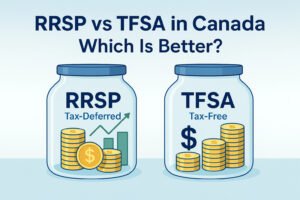
- Registered accounts. Gains inside a TFSA are tax-free, and gains inside an RRSP are tax-deferred until withdrawal. Holding growth investments in registered accounts is the simplest way to avoid capital gains tax — see our guide on whether to use a TFSA or RRSP.
Does it work the same for stocks, crypto, and real estate?
The three-step formula applies to most investments. Stocks, ETFs, mutual funds, and cryptocurrency are all treated as capital property, so the 50% inclusion rate and your marginal tax rate work the same way. Two differences are worth knowing. First, a crypto-to-crypto trade is a disposition for tax purposes, so it can trigger a capital gain even if you never converted to dollars. Second, real estate other than your principal residence — a cottage, rental, or second property — is taxable and often involves much larger gains, so the same percentages translate into a far bigger tax bill.
Whatever the asset, the math is identical, so you can run any scenario in our capital gains tax calculator or explore our other free financial calculators.
Frequently asked questions
Subtract your adjusted cost base and selling costs from the sale proceeds to get the capital gain, multiply by the 50% inclusion rate to get the taxable capital gain, then apply your marginal tax rate. Only half of a capital gain is taxable, and it is taxed as ordinary income.
The inclusion rate is 50%, meaning half of a capital gain is added to your taxable income. A proposed increase for larger gains was announced in 2024 and later cancelled, so the 50% rate still applies. Confirm the current rate with the CRA before filing.
It depends on your marginal tax rate and province. As a rule of thumb, your tax is roughly the gain times 50% times your combined marginal rate. On a $10,000 gain at a 30% marginal rate, that is about $1,500 in tax.
Usually no. The principal residence exemption generally eliminates capital gains tax on the home you live in, although you must still report the sale on your return. A second property or rental is taxable.
Yes. Capital losses offset capital gains, holding investments in a TFSA or RRSP shelters the growth, and the timing of a sale can shift the gain into a lower-income year. Net losses can be carried back three years or forward indefinitely.
Last updated: June 2026 · Based on the 50% capital gains inclusion rate. Confirm current rules with the CRA.
This article is general information, not tax advice. Tax rules, inclusion rates, and provincial rates change and depend on your personal situation. Confirm current rules with the Canada Revenue Agency or a qualified tax professional before filing or making decisions.