How to Calculate Your Marginal Tax Rate in Canada
Your marginal tax rate is the rate of tax you pay on your next dollar of income, combining the federal and provincial brackets you fall into. It is not the rate you pay on your whole income. This guide shows how Canada’s tiered brackets work, how to find your own marginal rate, and why it drives almost every tax decision you make.
Your marginal tax rate is the combined federal plus provincial rate applied to your highest, or last, dollar of income. Find it by locating the tax bracket your taxable income lands in, then adding the federal rate for that bracket to your province’s rate for the matching bracket. It is always higher than your average tax rate, because Canada taxes income in tiers, not all at one rate.
What a marginal tax rate actually means
Canada uses a progressive tax system. Income is divided into bands called tax brackets, and each band is taxed at its own rate. You do not pay one single rate on everything you earn. Instead, the first slice of income is taxed at the lowest rate, the next slice at a higher rate, and so on.
Your marginal tax rate is the rate that applies to the top slice, the next dollar you earn. If a raise, a bonus, an RRSP withdrawal, or a capital gain pushes more income into your return, that extra income is taxed at your marginal rate, not your average rate. That is exactly why the marginal rate matters: it tells you the real tax cost of one more dollar of income, and the real tax saving from one more dollar of deduction.
A common myth is that earning more money and moving into a higher bracket can leave you worse off. It cannot. Only the income inside the higher bracket is taxed at the higher rate. The dollars below that threshold keep their lower rates.
How Canada’s tax brackets work
Two layers stack together to make your marginal rate:
- Federal brackets apply everywhere in Canada. The federal system has five rate bands, historically about 15%, 20.5%, 26%, 29%, and 33%, rising as income rises.
- Provincial or territorial brackets sit on top, and every province sets its own rates and thresholds. This is why two people earning the same salary in different provinces can have different marginal rates.
Your combined marginal rate is the federal rate for your top bracket plus the provincial rate for your top bracket. In most provinces a middle-income earner sits somewhere around the high-20s to high-30s percent combined, while top earners can exceed 50% combined in several provinces.
The exact dollar thresholds change every year, because the federal government and the provinces index their brackets to inflation, and rates themselves are occasionally adjusted. For that reason the numbers below are illustrative round figures to show the mechanic, not the official current thresholds. Always confirm the live brackets on the CRA’s income tax rates page before relying on a number.
How to calculate your marginal tax rate
There are three steps:
The one step people get wrong is the first. Your marginal rate is based on taxable income, which is your income after deductions, not your gross salary. Making an RRSP contribution lowers your taxable income and can move you into a lower bracket, which is one of the main reasons RRSPs are valuable.
An illustrative example
Suppose a simplified federal-plus-provincial set of brackets looked like this (illustrative only):
| Taxable income band | Combined rate |
|---|---|
| $0 – $55,000 | 20% |
| $55,000 – $110,000 | 30% |
| $110,000 – $175,000 | 38% |
| Over $175,000 | 45% |
If your taxable income is $90,000, your income reaches into the second band, so your marginal rate is 30%. The next dollar you earn is taxed at 30%, and a $1,000 RRSP contribution would save you about $300 in tax. But you do not pay 30% on the whole $90,000. The first $55,000 is taxed at 20% and only the $35,000 above that is taxed at 30%.
Marginal rate vs average (effective) tax rate
This is the distinction that trips up most people. Your average tax rate, sometimes called your effective rate, is the total tax you pay divided by your total income. Because the lower brackets pull the blend down, your average rate is always lower than your marginal rate.
Using the illustrative brackets above for a $90,000 income:
| Tax on first $55,000 (at 20%) | $11,000 |
| Tax on next $35,000 (at 30%) | $10,500 |
| Total tax | $21,500 |
The total tax of $21,500 on $90,000 is an average rate of about 24%, even though the marginal rate is 30%. Use the average rate to understand your overall tax burden, and the marginal rate to make decisions, because every new dollar of income or deduction is valued at the margin.
See your marginal rate at work
Our capital gains calculator applies the correct combined federal and provincial brackets for your province automatically.
Why your marginal rate matters for everyday decisions
Almost every personal-finance tax decision in Canada hinges on your marginal rate:
- RRSP contributions and withdrawals. A contribution saves tax at your marginal rate today; a withdrawal is taxed at your marginal rate in the year you take it. The strategy is to contribute in high-rate years and withdraw in low-rate years. When you cash out an RRSP, tax is withheld up front but the final bill is settled at your marginal rate, which is what our guide to RRSP withholding tax rates walks through.
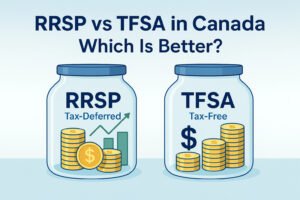
- TFSA vs RRSP. The right account often comes down to whether your marginal rate is higher now or expected to be higher in retirement. See our guide on choosing between a TFSA or RRSP.
- Capital gains. Only half of a capital gain is taxable in Canada, but that taxable half is taxed at your marginal rate, so your rate decides the real cost. Our guide to calculating capital gains tax shows the full three-step math.
- Bonuses and side income. Extra income stacks on top of your salary, so it is taxed at your marginal rate, which is why a bonus can feel like it is taxed heavily even though only the top slice is.
A quick way to find your real marginal rate
The cleanest way to find your actual combined marginal rate is to look up the current combined federal-and-provincial bracket table for your province, then find the band your taxable income lands in. Because the calculations behind income, deductions, and brackets can get involved, many people just run their numbers through a tool. You can explore our free financial calculators for tax and retirement estimates, including the capital gains calculator, which already bakes in the combined brackets for every province.
Frequently asked questions
Your marginal tax rate is the rate on your next dollar of income, set by the top bracket your income reaches. Your average (effective) tax rate is your total tax divided by your total income. The average is always lower, because the lower brackets tax part of your income at lower rates.
Find your taxable income (income after deductions such as RRSP contributions), locate the federal and provincial bracket it falls into, and add the federal rate for that bracket to your province’s rate for that bracket. The sum is your combined marginal rate. Confirm current brackets on the CRA website, as they change yearly.
No. Only the income inside the higher bracket is taxed at the higher rate. The dollars below that threshold keep their lower rates, so earning more always leaves you with more after tax, never less.
No. The federal portion is the same across Canada, but each province sets its own rates and thresholds, so your combined marginal rate depends on where you live as well as how much you earn.
An RRSP contribution reduces your taxable income, so it saves tax at your marginal rate. A $1,000 contribution at a 35% marginal rate saves about $350. Withdrawals are taxed at your marginal rate in the year you take them, so contributing in high-rate years and withdrawing in low-rate years is the goal.
Last updated: June 2026 · Bracket thresholds shown are illustrative; confirm current federal and provincial rates with the CRA.
This article is general information, not tax advice. Tax brackets, rates, and thresholds change yearly and depend on your province and personal situation. Confirm current rates with the Canada Revenue Agency or a qualified tax professional before making decisions.