What Is the 4% Rule for Retirement?
The 4% rule is a simple guideline for spending your savings in retirement: in your first year, you take out 4% of your nest egg, and after that you give yourself a small raise each year to keep up with rising prices. The idea is that a sensibly invested pot of money can support that spending for about 30 years without running dry.
The 4% rule says you can withdraw 4% of your retirement savings in the first year, then adjust that dollar amount for inflation each year after. Flipped around, it also means you need roughly 25 times your yearly spending saved up. On a $1,000,000 portfolio, that first-year withdrawal is $40,000.
What the 4% rule actually says
Here is the part people often get wrong. The 4% rule does not mean “take out 4% of whatever your balance is each year,” and it does not mean “spend your investment returns.” It works like this:
- Year one: take out 4% of your starting savings. If you have $1,000,000, that is $40,000.
- Every year after: take the same dollar amount and bump it up a little for inflation. If prices rose 3%, next year you take $41,200, then keep adjusting from there. This built-in inflation adjustment is also why FIRE projections should be run in real rather than nominal returns.
You set the spending amount once and let it drift up with the cost of living. You are not recalculating 4% of a new balance every year. The goal is to keep that income steady for a roughly 30-year retirement.
Put together, a $1,000,000 starting point might look like about $40,000 in year one, roughly $41,200 in year two, and around $42,400 in year three — a steady income that rises gently with prices, no matter what the market did in those years.
The 25 times shortcut
Because 4% is one twenty-fifth, the rule gives you a quick way to find your retirement target: multiply your yearly spending by 25. If you expect to spend $40,000 a year, you need about $1,000,000. If you expect $60,000 a year, you need about $1,500,000. This “25 times” shortcut is the same idea as the 4% rule, just viewed from the other direction, and it is the number most early-retirement plans aim for. On a larger nest egg the math is identical: $3,000,000 supports a $120,000 first-year withdrawal. Because everything scales off that one spending estimate, getting it right moves your target more than any withdrawal-rate debate — our guide on how to budget for FIRE covers the expenses people miss, and if you own your home, check whether home equity should count toward your FIRE number before you multiply.
Find your own number
Enter your spending and savings to see your 4% rule target and withdrawals.
Where the 4% number comes from
The 4% rule is not a number someone picked out of the air. Back in the 1990s, a US financial advisor named William Bengen went through decades of real market history and asked a simple question: what is the most a retiree could have safely taken out each year, through good markets and bad, without running out of money over a 30-year retirement? The answer that held up across all those past periods was about 4%. Other researchers checked the idea and got similar results, and the “4% rule” stuck as a rule of thumb.
Why about 4% works
The rough intuition is easy to see. A balanced mix of investments — say 60% stock funds and 40% bonds — has historically grown around 7% to 8% a year on average, while prices rise about 2% to 3% a year. So in a typical year, your money grows faster than the 4% you take out, even after inflation, which lets the pot refill what you spend. You can see how a balanced portfolio compounds over time with our compound interest calculator.
Taking only about 4% leaves a deliberate cushion. That cushion is not really there for the average year, which usually looks fine. It is there for the bad years, and for the simple fact that no one can predict when those bad years will arrive.
The big catch: the order of the bad years
This is the part the simple math hides, and it is the reason the safe number is around 4% rather than the 5% or 6% the averages alone might suggest. The order of good and bad years matters enormously.
If a serious market drop lands in your first few years of retirement — while you are also pulling money out to live on — your savings can take a wound they never fully heal from. You are selling investments at low prices to fund your spending, so there is less left to recover when the market eventually bounces back. Someone who retires right before a long bull market can spend far more than someone who retires right before a crash, even if the average return over their whole retirement is identical. The 4% cushion exists to survive that bad timing.
Is the 4% rule always safe?
Treat the 4% rule as a sensible starting point, not a promise. A few things change the picture:
- How long your money needs to last. The original research assumed about 30 years. If you retire early and need the money to last 40 or 50 years, a slightly lower rate, closer to 3.5%, is safer.
- How you invest. A portfolio with more stocks has historically supported a slightly higher safe rate, and a very conservative, low-return one a lower rate. But the difference is smaller than it sounds, because more stocks also means bigger swings and more of that bad-timing risk.
- How flexible you are. Retirees who are willing to trim their spending a little after a bad market year can safely start a bit higher than those who spend the same amount no matter what.
In real life, most retirees treat the 4% rule as a dashboard rather than autopilot. They start near 4%, check their balance and spending every year or two, and ease off a little after a rough market stretch or spend a bit more after a strong one. Used that way — as a flexible guide rather than a fixed promise — it stays one of the simplest, most useful starting points in retirement planning.
For a second take on the rule and its history, Investopedia has a clear overview of the 4% rule. And because the safe number depends on your own timeline and spending, the most useful step is to run your situation through a tool rather than rely on the round number alone. Our FIRE calculator and Coast FIRE calculator do exactly that, or you can browse all of our free financial calculators.
Does the 4% rule cover taxes?
One practical point the rule leaves out: the 4% is what you withdraw, not necessarily what you get to keep. Taxes usually come out of that amount, and how much depends on where your savings sit.
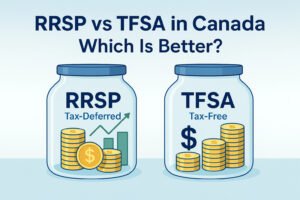
Money in a tax-deferred account, like an RRSP in Canada or a 401(k) in the US, is taxed as income when you take it out, so a $40,000 withdrawal can leave you with less to spend. Money in a TFSA or a Roth account comes out tax-free. Two retirees following the exact same 4% rule can end up with very different spendable income depending on the mix of accounts they built. If you are deciding where to save, our guide on whether to use a TFSA or RRSP walks through the trade-offs.
Frequently asked questions
Multiply your expected yearly spending by 25. To spend $40,000 a year you need about $1,000,000; to spend $60,000 you need about $1,500,000. That target is the same as taking out 4% in the first year.
No, and this is the most common mix-up. You take 4% in the first year, then keep that same dollar amount and adjust it for inflation each year. You do not recalculate 4% of a new balance annually, which would make your income jump around with the market.
It remains a reasonable guideline, but it is not a guarantee. It was built around a 30-year retirement, so longer retirements, lower expected returns, or a badly timed market drop can all argue for starting a little lower, around 3.5%.
It is a useful starting point, but early retirees often need their money to last 40 to 50 years rather than 30. For those longer horizons, many planners use a slightly lower withdrawal rate to be safe.
Sometimes, but be careful. Higher returns do not directly translate into a higher safe withdrawal rate, because the risk is bad timing, not the average return. Staying flexible and trimming spending after poor years is a safer way to spend a bit more than simply raising the rate.
Last updated: June 2026
This article is general information, not financial advice. The 4% rule is a guideline based on historical data and does not guarantee any outcome. Investment returns are not guaranteed and can be negative. Confirm your retirement plan with a qualified professional.