
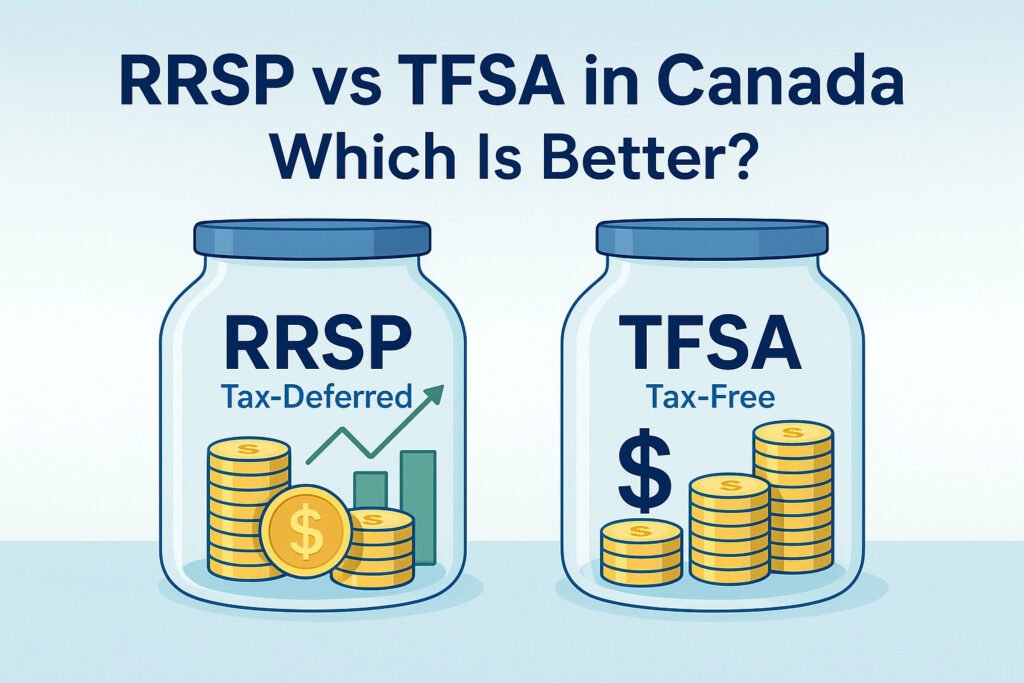
When it comes to personal finance in Canada, two of the most popular investment vehicles are the Registered Retirement Savings Plan (RRSP) and the Tax-Free Savings Account (TFSA). Both accounts come with powerful tax advantages, but they work in different ways and are suited for different financial goals. If you’re wondering about the difference between an RRSP and TFSA, and which one is right for you, this guide will help.
What Is an RRSP in Canada?
An RRSP (Registered Retirement Savings Plan) is designed primarily for retirement savings.
- Tax Deduction: Contributions to your RRSP are tax-deductible, which means you can reduce your taxable income. For example, if you earn $60,000 a year and contribute $10,000, you may only be taxed on $50,000.
- Tax-Deferred Growth: Investments inside your RRSP grow tax-free until you withdraw them.
- Withdrawals: Money taken out of your RRSP is taxed as income, usually when you retire. Because most people are in a lower tax bracket in retirement, this can result in significant tax savings.
- Contribution Limit: Up to 18% of your previous year’s income, capped at an annual maximum (for 2025, about $32,490). Unused room carries forward.
👉 Best for: Canadians with higher incomes who want immediate tax relief and are saving long-term for retirement.
What Is a TFSA in Canada?
A TFSA (Tax-Free Savings Account) offers complete flexibility and is ideal for both short- and long-term goals.
- No Tax Deduction: Contributions are not tax-deductible, but…
- Tax-Free Growth: All investment income (interest, dividends, capital gains) is completely tax-free—even when you withdraw.
- Withdraw Anytime: You can withdraw funds at any time without tax penalties. The withdrawn amount is added back to your contribution room the following year.
- Contribution Limit: In 2025, the annual limit is $7,000, with cumulative room since 2009 reaching about $95,000 for those eligible.
👉 Best for: Canadians who want flexibility, plan to use money for big purchases (like a home or car), or want their investments to grow tax-free without withdrawal restrictions.
RRSP vs TFSA: Key Differences
| Feature | RRSP | TFSA |
|---|---|---|
| Main Purpose | Retirement savings | Flexible savings & investments |
| Tax Advantage | Contributions are tax-deductible | Withdrawals are 100% tax-free |
| Growth | Tax-deferred | Tax-free |
| Withdrawals | Taxed as income | No tax, anytime |
| Contribution Limit | 18% of income (up to annual max) | Annual limit ($7,000 in 2025) |
| Best For | High earners planning retirement | All Canadians, especially young savers |
Example: A Canadian Worker Earning $60,000
Imagine you earn $60,000 per year and contribute $10,000:
- RRSP: You get an immediate tax refund (about $2,800 if your tax rate is 28%). Your investments grow tax-free until retirement. When you withdraw at a lower tax bracket, you save money overall.
- TFSA: You don’t get a tax refund upfront, but all future growth is 100% tax-free. If your $10,000 grows to $20,000, you can withdraw it tax-free anytime.
👉 If you want short-term flexibility, TFSA wins.
👉 If you want retirement tax savings, RRSP wins.
Where to Open an RRSP or TFSA in Canada
You can open both RRSPs and TFSAs at:
- Banks (RBC, TD, Scotiabank, BMO, CIBC) – safe and beginner-friendly
- Online Brokers (Questrade, Wealthsimple Trade, TD Direct Investing) – best for DIY investors
- Robo-Advisors (Wealthsimple Invest, Questwealth) – great for hands-off investing
Final Thoughts: RRSP or TFSA?
Both RRSPs and TFSAs are essential tools for Canadians. The best choice depends on your income, tax bracket, and financial goals:
- Prioritize TFSA if you want flexibility, tax-free growth, and access to your money anytime.
- Prioritize RRSP if you want to lower taxes now and plan for retirement in a lower tax bracket.
- Ideally, use both—start with a TFSA for flexibility, then maximize RRSP contributions when your income rises.