What Is Dollar-Cost Averaging?
Dollar-cost averaging means investing a fixed amount of money on a regular schedule — say $500 on the first of every month — no matter what the price is that day. Instead of trying to guess the perfect moment to buy, you buy a little at a time, automatically, and let the highs and lows average out.
Dollar-cost averaging (DCA) is the habit of investing the same dollar amount at regular intervals, regardless of price. Your fixed amount automatically buys more shares when prices are low and fewer when prices are high, which removes the pressure of timing the market. If you contribute to a workplace retirement plan from each paycheck, you are already doing it.
What dollar-cost averaging actually is
The whole idea rests on two simple rules: a fixed amount and a fixed schedule. You decide how much (for example, $300) and how often (weekly, every paycheck, or monthly), and then you invest that amount every time without trying to predict where prices are headed.
Because the dollar amount stays the same, the number of shares you buy changes with the price. When the market dips, your $300 buys more units; when it climbs, the same $300 buys fewer. Over time this tends to pull your average cost per share below the average price during the period, which is where the “averaging” in the name comes from.
How it works: a simple example
Say you invest $300 each month into the same fund for three months, and the price moves around:
| Month | Price | Invested | Shares bought |
|---|---|---|---|
| Month 1 | $30 | $300 | 10.0 |
| Month 2 | $20 | $300 | 15.0 |
| Month 3 | $25 | $300 | 12.0 |
| Total | avg price $25 | $900 | 37.0 |
You invested $900 and ended up with 37 shares, so your average cost was about $24.32 per share ($900 ÷ 37). Notice that this is lower than the simple average price of $25 over the three months. By spending a fixed amount, you automatically bought more shares in the cheap month and fewer in the expensive one, which nudged your average cost down.
The contrast makes the point clearer. If you had instead bought a fixed number of shares each month — say 12 every time — your average cost would simply equal the average price of $25. Fixing the dollar amount rather than the share count is the small trick that tilts the average in your favour when prices bounce around.
Why people use it
- It removes the guesswork. You never have to decide whether today is a good day to buy, which is a decision almost no one gets consistently right.
- It takes the emotion out. Investing on autopilot stops you from buying in a frenzy when markets are high and freezing when they fall.
- It builds a habit. A fixed, automatic contribution turns investing into a routine instead of a series of stressful choices.
- It works with how most people earn. Money arrives every paycheck, so investing a slice of each one is naturally dollar-cost averaging.
How to start dollar-cost averaging
Setting it up takes four steps:
- Pick an amount you can comfortably invest every period without needing it back soon.
- Pick a schedule — lining it up with your pay is the easiest.
- Automate it so the money moves before you can second-guess it. Most brokerages and workplace retirement plans let you set up automatic contributions.
- Choose where it goes — for most people a low-cost, broadly diversified index fund keeps both risk and fees down.
Then comes the hard part: leave it alone. The whole benefit of dollar-cost averaging comes from sticking with it through both good and bad markets. If you want a second source, the US Securities and Exchange Commission’s investor education site has a short plain-language note on dollar-cost averaging.
Does it count as DCA if you buy sector funds or single stocks?
This is a common debate, and the answer is straightforward: dollar-cost averaging is defined by how you buy, not what you buy. The method is the fixed amount on a fixed schedule. You can dollar-cost average into a broad index fund, a single sector fund, or even one company’s stock — it is still dollar-cost averaging.
What changes with the choice of investment is the risk, not the method. A broad, diversified index fund spreads your money across hundreds of companies, so a single bad business does little harm. Putting every contribution into one sector or one stock concentrates the bet, which can mean bigger gains but also much bigger losses. So you can absolutely dollar-cost average into anything; just be clear that diversification, not the schedule, is what controls how risky the plan is.
See how steady investing grows
Add regular contributions and watch compounding do the work over time.
Dollar-cost averaging vs investing a lump sum
Here is the honest, evidence-based part. If you already have a large amount of cash sitting ready, history says investing it all at once has usually beaten spreading it out. Studies of past markets, including well-known research from Vanguard, found that lump-sum investing came out ahead of dollar-cost averaging roughly two-thirds of the time. The reason is simple: markets rise more often than they fall, so money put to work sooner has more time to grow.
So why dollar-cost average at all? Two good reasons. First, most people do not have a big lump sum waiting; they invest out of each paycheck, and for them DCA is just how investing happens. Second, even when you do have a lump sum, spreading it out can protect you from the worst-case regret of investing everything the day before a crash. Dollar-cost averaging trades a bit of expected return for peace of mind and steadier nerves — and an investor who actually sticks with the plan beats one who panics and sells. A common middle path is to put a lump sum to work over a few months rather than years, capturing most of the time-in-market benefit while still softening the timing worry.
Doing it inside a retirement account
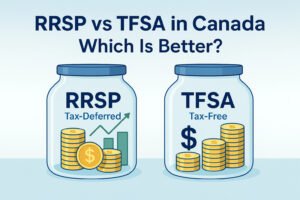
Dollar-cost averaging fits naturally inside tax-sheltered accounts, and most people are already using it there without realizing. In Canada, automatic monthly contributions to a TFSA or RRSP are dollar-cost averaging; in the US, the slice of every paycheck that flows into a 401(k) is the same idea. Because these accounts shelter your growth from tax — a TFSA or Roth tax-free, an RRSP or 401(k) tax-deferred — steady contributions compound more efficiently than they would in a regular taxable account. If you are deciding which account to fill first, our guide on whether to use a TFSA or RRSP walks through the trade-offs.
The limits to keep in mind
Dollar-cost averaging is a sensible habit, not magic. It does not guarantee a profit and does not protect you from losing money if the investment keeps falling. In a market that mostly rises, holding cash to invest later can leave you worse off than investing sooner. And it works best paired with low costs and a long time horizon, where compound interest has years to build on each contribution. For a deeper look at how to put a regular-investing plan to work toward retirement, our compound interest calculator and other free financial calculators let you test different contributions and timelines. And when you review how the plan is doing, measure it honestly — including fees and dividends — using the steps in our guide on how to calculate ROI.
Frequently asked questions
It is investing a fixed dollar amount on a regular schedule, such as $500 every month, no matter the price. Your fixed amount buys more shares when prices are low and fewer when they are high, so you do not have to time the market.
For most people investing from each paycheck, yes — it is disciplined, automatic, and removes the stress of timing. If you have a large lump sum ready, investing it all at once has historically earned more on average, but DCA can reduce the risk of bad timing.
No. It does not guarantee a profit or protect against losses if the investment keeps falling. It is a way to invest steadily and reduce timing risk, not a way to remove market risk.
Yes. Dollar-cost averaging is about the method — a fixed amount on a fixed schedule — not what you buy. You can use it for an index fund, a sector fund, or a single stock, though a single stock concentrates your risk.
Any regular schedule works, and matching it to your pay is the simplest approach. Weekly, every paycheck, or monthly are all common. The key is consistency, not the exact frequency.
Last updated: June 2026
This article is general information, not financial or investment advice. Investing involves risk, including the possible loss of principal, and dollar-cost averaging does not guarantee a profit or protect against loss. Past market behaviour does not predict future results. Confirm any strategy with a qualified professional.